IndustriElectric
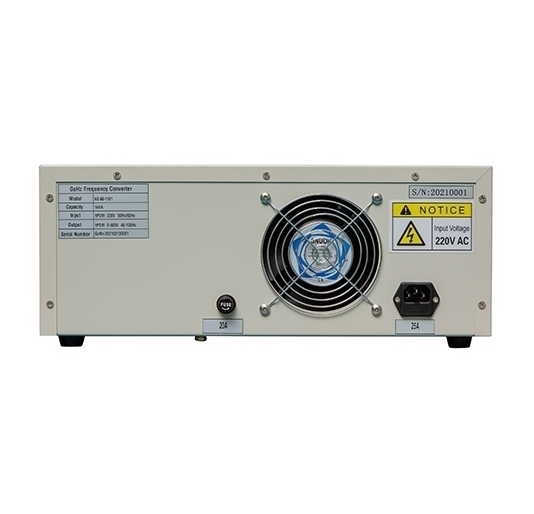
1 kVA Frequency Converter 60Hz to 50Hz
1 kVA Frequency Converter 60Hz to 50Hz
Couldn't load pickup availability
1 kVA solid state frequency converter, converting single phase 110V/120V 60Hz to 220V/230V/240V 50Hz in one step.
Specification
| Model | HZ-60-1101 | |
| Dimension | 420*330*180mm | |
| Weight | 45 kg | |
| Input | Voltage | 1 Phase 2 Wire: 110V/120V, 220V/230V/240V ± 10% (option *) |
| Frequency | 50 Hz, 60 Hz or 400 Hz ± 5% | |
| Output | Voltage, current | 120V Setting (Low grade): 0-150V, 8.4A |
| 240V Setting 0-300V (High grade): 0-300V, 4.2A | ||
| Load stabilization Rate | ≤±1% | |
| Frequency | 50Hz, 60Hz up to 400Hz adjustable Note: -When the output is 400Hz, the load capacity can only reach 50% of the rated capacity. -When the output is ≤120Hz, the load capacity can reach 100% of the rated value. -You can just adjust converter output frequency in the range (40-400Hz) for 400Hz option. |
|
| Frequency Stability | ≤±0.01% | |
| Harmonic Distortion | Pure Sine Wave ≤2% | |
| Frequency meter | 4 digit, digital frequency meter, resolution 0.1Hz/Step | |
| Voltmeter | 4 digit, digital voltage meter, resolution 0.1V | |
| Ammeter | 4 digit, digital ammeter, resolution 0.1A | |
| Watt meter | 4 digit, digital Watt meter, resolution 0.1W | |
| Protection | With overload, short circuit, over temperature | |
| Instantaneous power failure protection and alarm device | ||
| Working Environment | Temperature | 0 - 40 deg.℃ |
| Humidity | 0 - 90% (Non condensation) | |
| Warranty | 18 months | |
* The input voltage is factory selected.
Tips: Where is 60 Hz (Hertz) or 50 Hz (Hertz) being used?
The US is not the only country 60 Hz is used. It is used throughout North America, much of Mexico, parts of Central and South America, and parts of Japan. This was not always the standard in the US, either. As late as the 1940's, Southern California Edison used 50 Hz, and 25 Hz systems existed in Ohio. Several other frequencies were used, too. Standardization on 60 Hz didn't come about quickly. There's a similar story behind the adoption of 50 Hz in most of the rest of the world, with several different frequencies having been used in Europe before they standardized on 50 Hz. Most of Asia followed Europe, because they adopted similar equipment and standards, especially everywhere the British Empire went (India, Pakistan, China, Sri Lanka, Malaysia). Other countries that wanted to interconnect with these early systems would have had an incentive to choose the same frequencies.
Share